
Lexington Court Records After Arrest
Court records after a jail arrest in Lexington County begin with a practical split. The Lexington County Sheriff's Department books the person into the Lexington County Detention Center and records the custody side of the event. The court side begins when the charge is filed, screened, or moved into the proper South Carolina court path. General Sessions matters are handled at the circuit level, while summary offenses may run through magistrate or municipal court. The Lexington County Clerk of Court supports General Sessions, Common Pleas, and Family Court records under the South Carolina Judicial Department.
South Carolina uses Solicitors instead of district attorneys. Lexington County is part of the Eleventh Judicial Circuit, and the Eleventh Judicial Circuit Solicitor's Office is the prosecuting office for Lexington, Edgefield, McCormick, and Saluda counties. The Solicitor's Office is important because booking charges can be screened, amended, dismissed, indicted, or resolved differently after the arrest. For current custody and booking details, use Lexington County jail inmate records. For booking photographs, use Lexington County jail roster mugshots. For the filed court case, use the Public Index and court channels below.
Lexington Public Index Search
The main online court channel is the South Carolina Judicial Branch Public Index for Lexington County. The Judicial Branch case-records gateway notes that cookies and JavaScript must be enabled, and some browsers may need pop-up exceptions to view case detail. The Public Index can include General Sessions criminal cases and some municipal court records where available. It is the better source for filed charges, dispositions, scheduled events, judges, bond entries, and docket activity after a Lexington County jail arrest.
Open the Lexington County Public Index when a case should have reached the public court system.
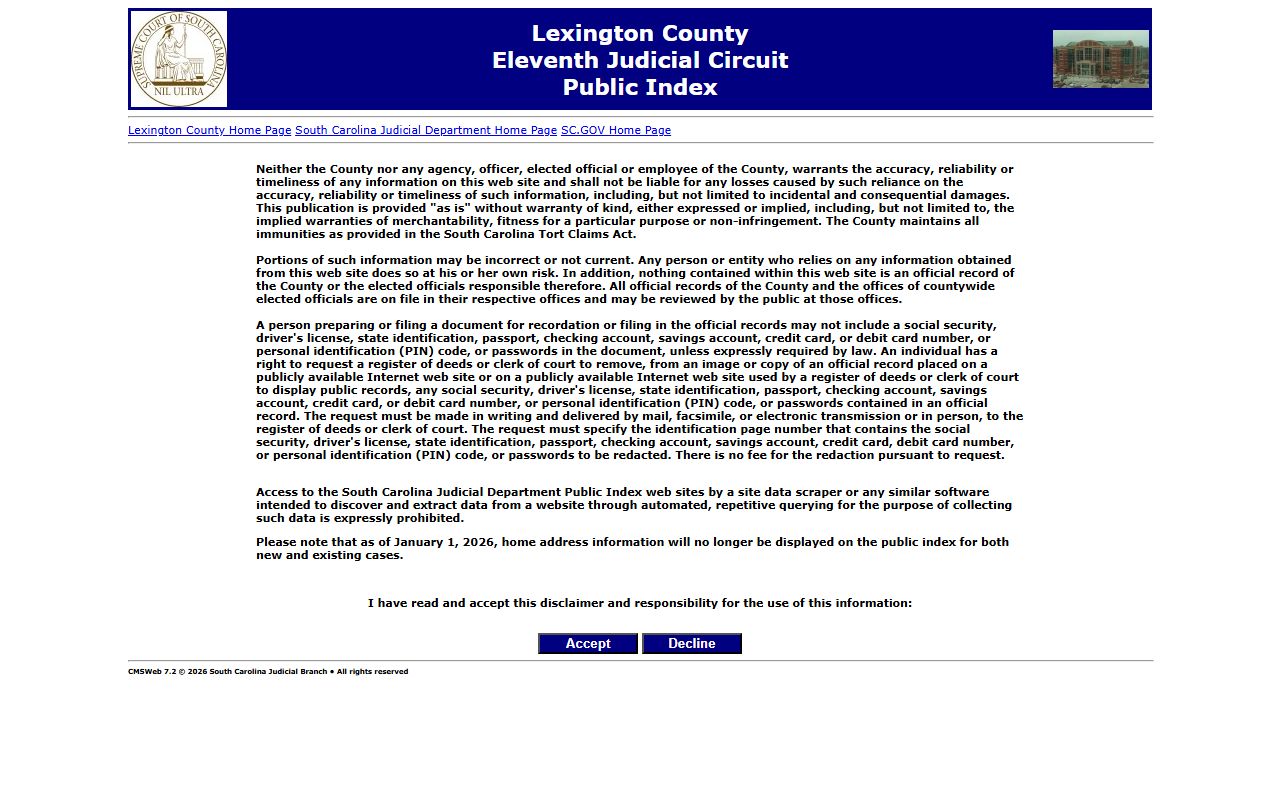
The screenshot shows the county-specific Public Index route. A case may not appear immediately after booking, so compare the booking name from the jail roster with the defendant name, case dates, and charge dates in the court index.
| Field Label | Type | Required | Options / Format Notes |
|---|---|---|---|
| County / Lexington County | Selection or route | Yes by URL | The Lexington Public Index route limits the search to Lexington County. |
| Search by case number | Text | No | Best when paperwork, a notice, or a docket entry gives the case number. |
| Search by party name | Text | No | Use the defendant's full first and last name when no case number is known. |
| Search by date / filed date | Date or filter | No | Useful when the name is common or an approximate booking date is known. |
| Case type / court type | Filter | No | Use criminal, General Sessions, magistrate, or municipal filters where available. |
| Search / Submit | Button | n/a | Runs the Public Index search. Browser settings can affect case-detail views. |
Find Court Records After Arrest
Start with the custody record only long enough to collect identifying details. The Lexington Sheriff P2C roster is designed for current county detention-center custody and booking photographs, not for complete court-history research. Once a court case exists, the Public Index is the better place to read the filed charge, the court division, hearing dates, warrant events, bond activity, and disposition. If the person has been transferred to state prison after sentencing, custody location moves to the South Carolina Department of Corrections locator, but the Lexington court case remains a court-record search.
- Check the jail roster if the person is still detained, and note the full name and booking charge wording.
- Open the Lexington County Public Index.
- Search by defendant or party name, using full first and last name.
- Use a case number if one appears on paperwork, bond documents, or a court notice.
- Review case detail for charges, disposition, court events, judge, bond entries, warrants, and hearing dates.
- If no case appears, allow time for filing or contact the Clerk of Court, Solicitor, magistrate court, or municipal court tied to the charge.
- For older files or certified copies, use the Clerk of Court channel rather than relying only on the web index.
Charges Filed After Arrest
A Lexington County jail arrest does not freeze the final charge list. The arresting agency may book a person on one wording, while the court record later uses a formal charging document, a screened charge, an amended charge, or an indictment. The Eleventh Judicial Circuit Solicitor is the main prosecuting agency for General Sessions charges. That office may evaluate evidence, work with law enforcement, prepare indictments, make nolle prosequi decisions, negotiate pleas, and handle eligible expungement applications.
The Eleventh Judicial Circuit Solicitor public-record links page routes court-record users back to the Lexington County Public Index.
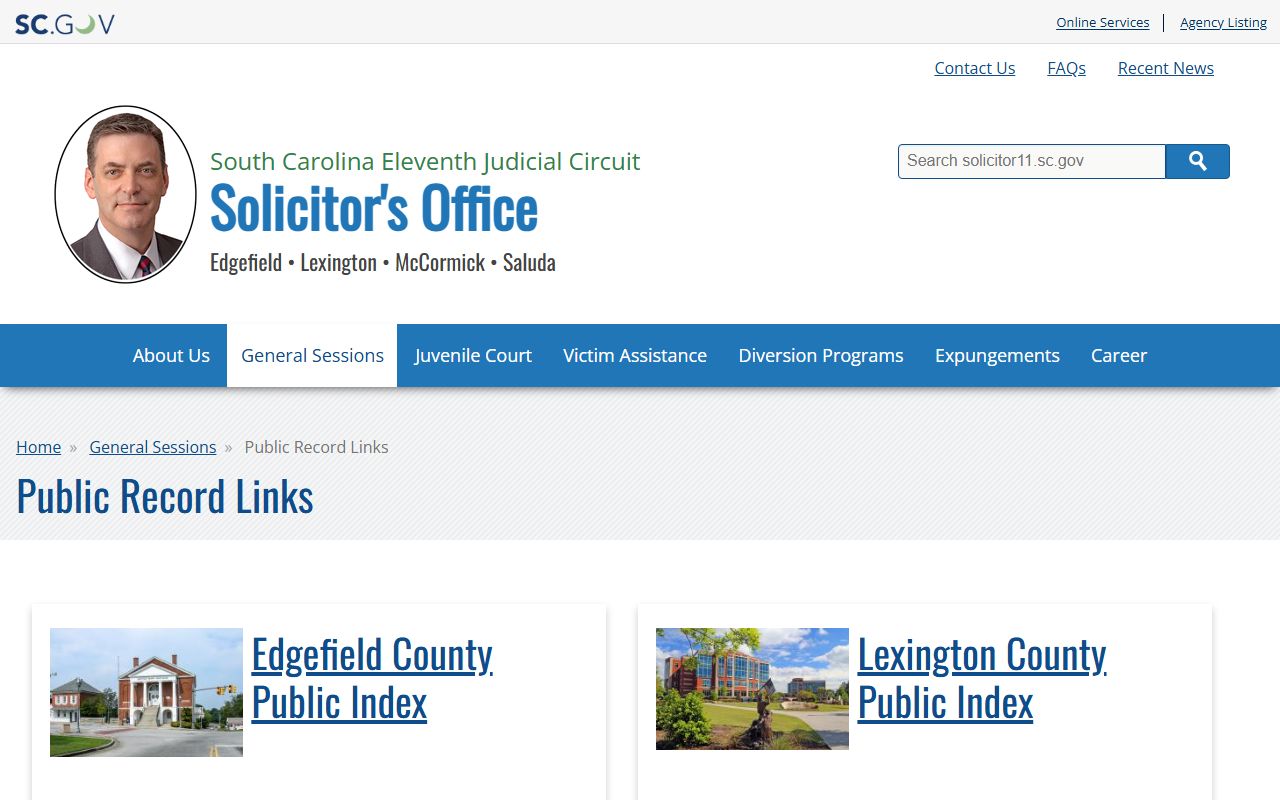
That routing matters because the Public Index is where a person can check whether the court charge differs from the jail booking charge after prosecutorial review.
| Document | Who Uses It | Where It Fits | What to Check |
|---|---|---|---|
| Complaint | Officer, prosecutor, magistrate, or municipal pathway depending on charge | Often appears early in the case path, especially for lower-level or preliminary matters. | Charge wording, date, court, and next appearance. |
| Information | Prosecutor | Can present a formal prosecution charge without using the same wording as the booking entry. | Whether the filed charge replaced or narrowed the arrest charge. |
| Indictment | Grand jury and Solicitor pathway | Common in serious General Sessions cases after screening. | Indicted offense, counts, case number, and later disposition. |
Lexington Charge Status
Charge status is the reason court records after an arrest should be checked more than once. A record may begin as pending, then show a bond event, a bench warrant, an amendment, a dismissal, a plea, or a trial disposition. Court charges can also move between summary court and General Sessions depending on the offense and filing path. The Public Index gives a snapshot of the court record, but timing matters because booking often happens before the public court index is updated.
| Status | Plain-English Meaning | Why It Matters |
|---|---|---|
| Pending | The charge has not reached final disposition. | Hearings, bond conditions, warrants, or amendments may still occur. |
| Amended | The charge wording or code changed in court. | The filed court charge may no longer match the original jail roster charge. |
| Reduced | The case moved to a lower or different offense. | Disposition and sentencing exposure may differ from the arrest charge. |
| Dismissed | The charge ended without a conviction on that charge. | Dismissal may support an expungement inquiry if statutory requirements are met. |
| Nolle prosequi | The prosecutor declined to pursue that charge. | The charge is not the same as a conviction, but the public record may still need review. |
| Conviction | A guilty plea or finding of guilt resolved the charge. | It is a final outcome, not merely an arrest or accusation. |
Bond and Warrant Pathway
Bond after a Lexington County arrest is handled through South Carolina magistrate, summary-court, and General Sessions pathways depending on the charge. South Carolina Code Title 17, Chapter 15 governs appearance recognizance and appearance bonds. The conditions focus on appearing before the specified court, answering the charge or indictment, staying within lawful limits, and following any other conditions imposed by the court. Serious charges, bench warrants, fugitive holds, parole or probation holds, out-of-county holds, federal holds, or ICE-related holds can prevent release even when a local bond appears available.
No separate public active-warrant search page for Lexington County was located in the official sources reviewed. LCSD Judicial Services is the official warrant channel identified in the research, and the Public Index may show warrant-related docket events once a court case exists. Call the jail at 803-785-2743 or detention information at 803-785-2740 to verify custody and release conditions. LCSD warns that it will not call and demand bail payment by phone, so confirm payment location and case details through official channels before sending money or contacting a bondsman.
| Path | Where to Check | Record Clue |
|---|---|---|
| Cash bond | Jail phone line and court record | Bond amount or court condition tied to the case. |
| Surety bond | Licensed bondsman plus court and jail confirmation | Surety involvement does not override other holds. |
| Personal recognizance | Bond court or case docket | Release based on promise to appear and comply. |
| Bench warrant | Public Index and court clerk channel | Often tied to failure to appear or court-order violation. |
| No-bond or detainer hold | Jail, court, SCDC, federal, or immigration channel as applicable | Release may be blocked even after local bond is addressed. |
Charges Versus Convictions
An arrest charge is an accusation supporting custody. A court charge is a formal item in the case record. A conviction is different from both. It requires a guilty plea, guilty finding, or other final outcome that qualifies as a conviction under the court record. For Lexington County court records after a jail arrest, the key reading habit is to separate the booking entry from the filed charge and then separate the filed charge from the final disposition.
| Point of Comparison | Charge | Conviction |
|---|---|---|
| Legal stage | Accusation filed or carried in court. | Final guilty plea or finding. |
| Where it appears | Jail roster, Public Index, charging document, or docket. | Disposition section, sentencing entry, or final judgment record. |
| Can change? | Yes. It may be amended, reduced, dismissed, or nolle prossed. | Changes usually require later court action, appeal, or post-disposition relief. |
| How to describe it | Use charged, accused, pending, or filed when no conviction appears. | Use convicted only when the court disposition supports it. |
Sealed and Expunged Records
South Carolina public access starts with the Freedom of Information Act and court-index access, but not every arrest-related record stays publicly visible. S.C. Code 17-1-40 specifically refers to arrest and booking records, associated bench warrants, mug shots, and fingerprints in the expungement and destruction context. When an eligible charge is discharged, dismissed, or results in not guilty and is expunged, the statute directs destruction or sealed retention rules, with exceptions for law-enforcement and prosecution retention tied to investigations, prosecution, administrative hearings, and litigation defense.
Expungement questions for Lexington County charges are routed through the Eleventh Judicial Circuit Solicitor's Office. S.C. Code 17-22-920 directs clerks of court to send expungement questions to the corresponding solicitor's office, and S.C. Code 17-22-930 requires the official blank expungement order form from the solicitor in the circuit where the charge originated.
| Point of Comparison | Sealed | Expunged |
|---|---|---|
| Public visibility | Limited or hidden from ordinary public view. | Removed or destroyed where the statute requires, with specified retention exceptions. |
| Record category | May apply to sensitive or restricted court material. | Can include eligible arrest, booking, bench warrant, mug shot, and fingerprint records. |
| Lexington route | Check the court that controls the record. | Start with the Eleventh Judicial Circuit Solicitor's Office for eligible charges. |
| Important limit | Not all restricted records disappear from all government access. | Does not automatically remove copies held by unofficial third parties. |
Restricted Court Records
Public court access does not mean every arrest-related detail is public. Juvenile records, sealed material, nonpublic investigative information, medical information, Social Security numbers, dates of birth, and some dismissed or expunged material may be withheld or redacted. Municipal or magistrate details may also require contacting the specific court when they do not appear in the Public Index. If the needed record is a booking record rather than a court record, use the LCSD FOIA request process through 521 Gibson Road, Lexington, SC 29072, or FOIA@lcsd.sc.gov.
FCRA notice: These lookup paths are not consumer reports and must not be used for employment, housing, credit, insurance, or other FCRA-covered decisions.
Public Record Search
Sponsored Results